
There has been a dramatic twist in the legal battle surrounding businessman and New Force leader Nana Kwame Bediako, popularly known as Cheddar, and his No. 1 Oxford Street Hotel in Osu, Accra.
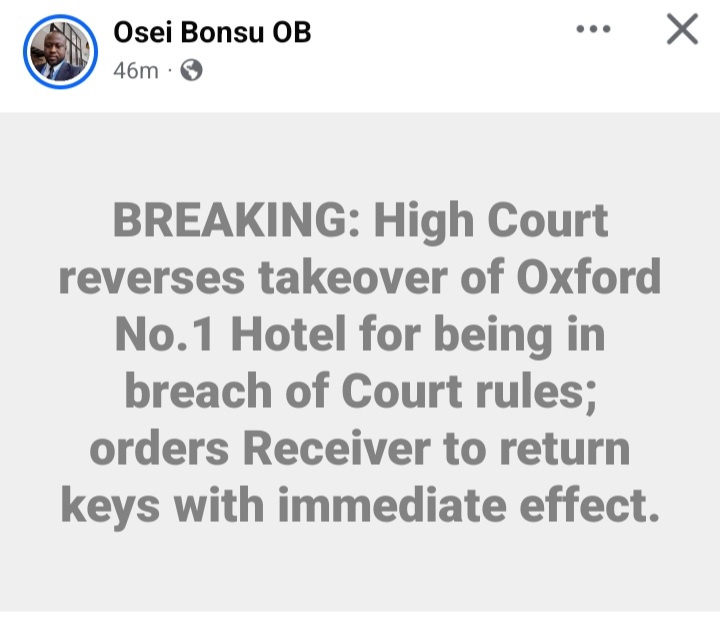
Media personality and lawyer Osei Bonsu OB, who is the host of Ekosiisen on Asempa FM, has reported that the High Court has reversed the earlier takeover of the hotel and ordered the Receiver to return the keys with immediate effect.
OB made the revelation in a Facebook post on Friday, August 21, 2026, and added that the court indicated that takeover had been reversed because it was allegedly carried out in breach of court rules.
The development comes weeks after the hotel became the centre of a major legal dispute involving Cola Holdings Limited, its appointed Receiver, Nii Amanor Dodoo, and Kensington Residential Partners 1 Limited, the company associated with the hotel.
The dispute escalated on July 21 when the Commercial Division of the Accra High Court granted Cola Holdings and the Receiver police assistance to take possession of the No. 1 Oxford Street Hotel.
The order followed an application by the Receiver after attempts to obtain possession of the property were reportedly unsuccessful.
The legal action was connected to an alleged debt of about US$14.9 million, arising from a judgment obtained in the United Kingdom. Cola Holdings subsequently sought to enforce the judgment and realise security connected to the hotel.
The court’s earlier decision generated significant public attention, with reports emerging that Cheddar’s prominent Oxford Street property had effectively been seized by the Receiver.
Cheddar, however, strongly disputed that characterisation.
Following the earlier court order, management of the hotel insisted that the property remained under the control and possession of Kensington Residential Partners 1 Limited.
Management also maintained that the hotel remained open for business and that legal steps had been taken to challenge the court’s decision.
Cheddar also previously reacted to the dispute, questioning attempts to hold him personally responsible for the financial obligation at the centre of the case.
He reportedly maintained that the facility in question was obtained by Kensington Residential Partners 1 Limited and argued that the matter involved a corporate obligation rather than a personal loan contracted by him.
He further raised concerns about the handling of the matter before the UK courts and indicated that his lawyers were taking steps to challenge the judgment and its enforcement in Ghana.