
The National Petroleum Authority (NPA) has issued an urgent directive to all Oil Marketing Companies (OMCs), fuel station operators, transporters and dealers across the country to immediately enforce strict safety measures at fuel stations affected by flooding, warning that non-compliance will attract regulatory sanctions and possible prosecution.
The directive comes in the wake of heavy rainfall and flooding in several parts of the country, raising serious concerns over potential risks such as fuel contamination, fire outbreaks, explosions and environmental pollution.
Immediate Suspension of Fuel Operations at Flooded Stations
In a public notice, the NPA instructed operators of affected fuel stations to immediately suspend all fuel dispensing, loading and offloading activities where floodwaters have entered forecourts, underground storage areas or critical operational zones.
The Authority emphasized that no fuel-related operations must continue at any station where water has compromised safety conditions.
Operators have also been directed to disconnect electrical systems, including fuel pumps, dispensers, canopy lighting and other forecourt equipment, where it can be safely done, to prevent electrical hazards.
All staff, customers and vehicles are to be evacuated immediately from affected stations.
100-Metre Safety Exclusion Zone Enforced
As part of the emergency safety protocol, the NPA has ordered the establishment of a minimum 100-metre safety exclusion zone around all flooded fuel stations.
Within this restricted zone, the Authority has strictly prohibited:
- Smoking
- Open flames or naked fire
- Welding activities
- Any operation capable of generating sparks
The directive is aimed at reducing the risk of ignition in environments where leaked petroleum products may be present in floodwater.
Emergency Reporting to Regulatory Agencies
The NPA further instructed operators to immediately report all affected stations to the nearest offices of:
- The National Petroleum Authority (NPA)
- The Ghana National Fire Service (GNFS)
- The Environmental Protection Agency (EPA)
- Their respective Oil Marketing Companies
The coordinated reporting is expected to support rapid emergency response and risk assessment.
Strict Conditions for Resumption of Operations
According to the Authority, no flooded fuel station will be allowed to resume operations until all safety conditions are fully met.
These include:
- Complete recession of floodwaters
- Joint inspection by the NPA and GNFS
- Certification that underground tanks, pipelines and dispensers are safe
- Proper removal and disposal of water-contaminated fuel and hazardous waste
The NPA stressed that all contaminated petroleum products must be handled in line with environmental and safety regulations, warning that violations will not be tolerated.
Public Warned to Stay Away from Flooded Fuel Stations
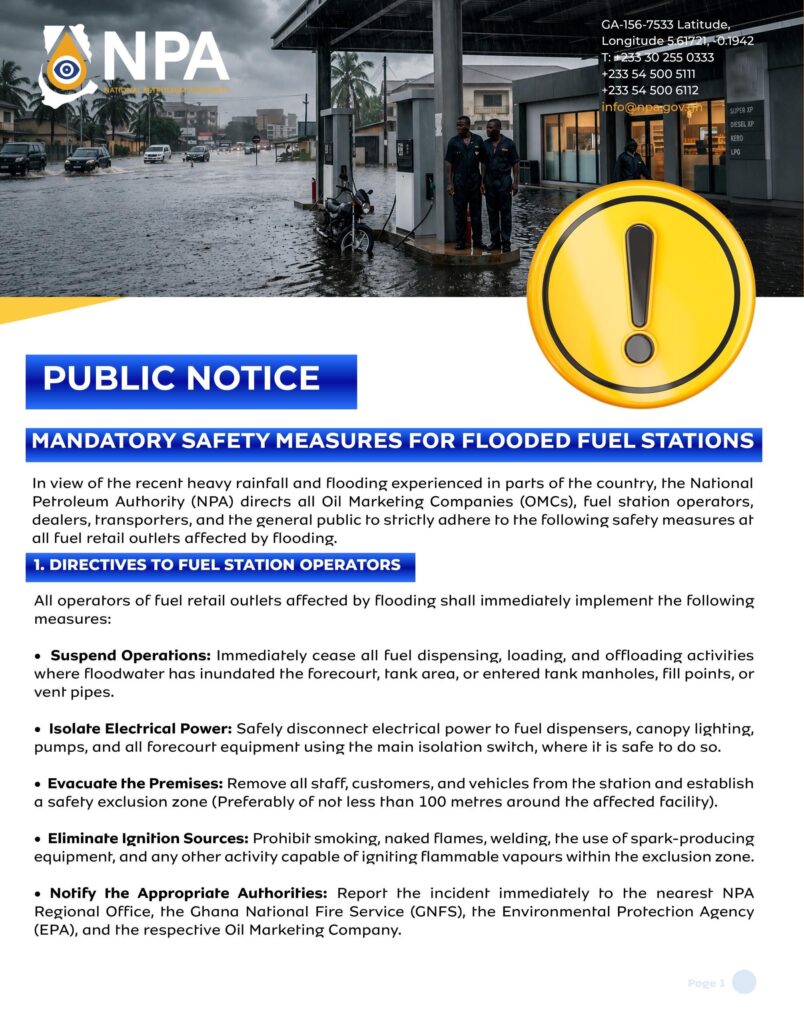
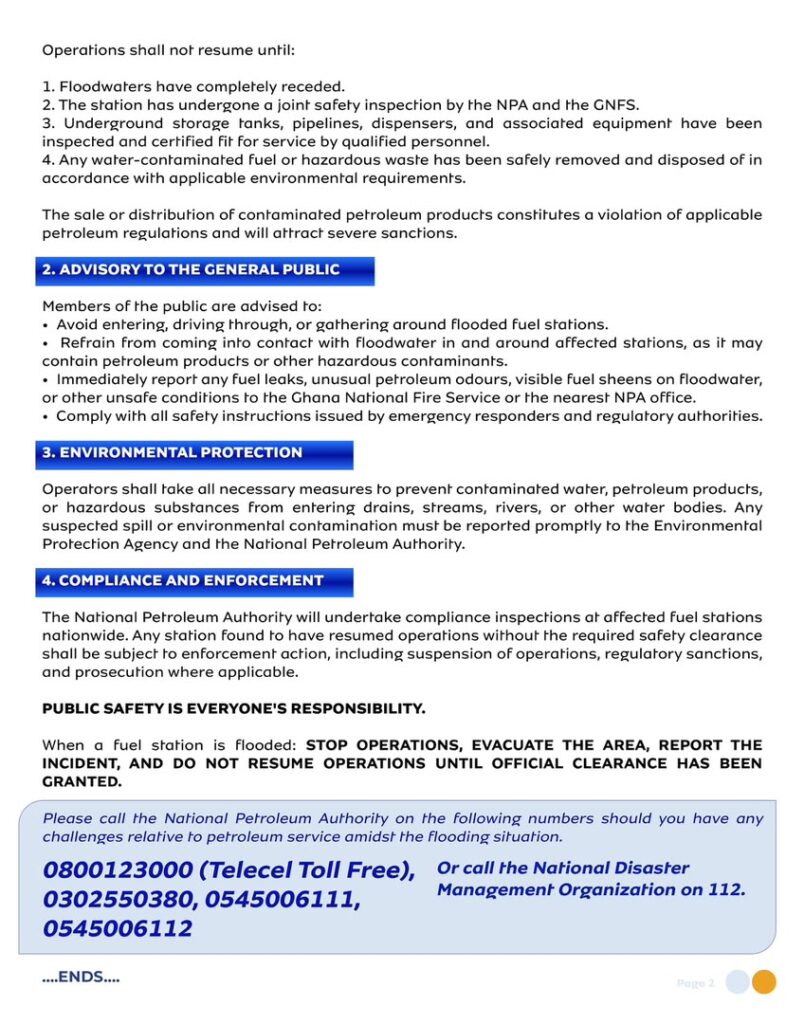
The Authority has also issued a strong public advisory, urging motorists and residents to avoid flooded fuel stations entirely.
Members of the public have been cautioned against:
- Entering flooded petrol stations
- Driving through station forecourts under water
- Gathering near affected facilities
- Contact with floodwater around fuel stations
The NPA warned that floodwater in such areas may be contaminated with petroleum products and other hazardous substances, posing serious health and safety risks.
Public Encouraged to Report Hazards
Citizens have been encouraged to report any signs of danger, including:
- Fuel leaks
- Strong petroleum odours
- Visible oil films on floodwater
- Any unsafe activity at fuel stations
Reports are to be made to the Ghana National Fire Service (GNFS) or the nearest NPA office, while individuals are urged to comply fully with emergency instructions.
Regulatory Crackdown Expected
The NPA cautioned that any fuel station found selling or distributing contaminated petroleum products will face severe regulatory sanctions.
The Authority reiterated its commitment to ensuring public safety, environmental protection and strict compliance within the downstream petroleum sector, especially during periods of flooding and adverse weather conditions.
As heavy rains continue to affect parts of the country, regulators say heightened vigilance and strict adherence to safety protocols remain critical to preventing potential disasters at fuel distribution points.